A wave of alarming claims about artificial intelligence’s environmental and community impact has swept through media, activist circles, and popular books over the past several years. Many of those claims trace back to a small number of flawed or misrepresented studies, misleading comparisons, and arithmetic errors that compounded through uncritical repetition. When the actual numbers are examined in context — divided by users, compared to analogous industries, and corrected for unit errors — the picture changes dramatically. AI and its supporting data centers are not uniquely environmentally destructive; they consume resources at levels comparable to, and often far below, dozens of other industries that generate far less public alarm. This article addresses each major claim in turn, with the underlying data and corrected comparisons.
Claim 1: “Training AI Models Emits a Catastrophic Amount of Carbon”
The Claim
Headlines following the release of GPT-3 and GPT-4 produced a cascade of alarming comparisons: “Training GPT-3 produced 552 tonnes of CO₂, equivalent to driving 112 gasoline-powered cars for a year.” Another framing: “GPT-4’s footprint is roughly equal to the annual emissions of 1,550 US citizens.” MIT Technology Review reported that training GPT-4 “consumed 50 gigawatt-hours of energy, enough to power San Francisco for three days.”
Why It’s Misleading
Every one of these comparisons has the same flaw: they measure the emissions of creating a product used by hundreds of millions of people against individual-scale activities. This is not a useful comparison for the same reason it would be absurd to say manufacturing all Coca-Cola cans is bad because one person’s car emits less. The correct frame is to compare GPT-4’s training cost to the manufacturing cost of other consumer products used by comparable numbers of people.
Using a high-end estimate of 15,000 tonnes of CO₂ for GPT-4 training (which already bakes in failed runs and embodied hardware):
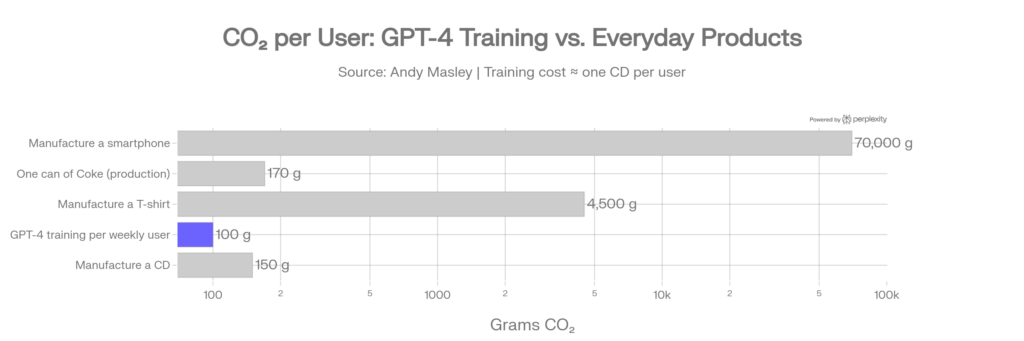
- Manufacturing all Grand Theft Auto 5 CDs: ~15,000 tonnes — essentially identical
- Manufacturing all iPhone 16 units: ~12,000,000 tonnes — 800× more
- Manufacturing Nike shoes for one month: ~150,000 tonnes — 10× more
- Building a single cruise ship: ~30,000 tonnes — 2× more
The per-user calculation is even more illuminating. With roughly 100–200 million weekly ChatGPT users at the time of GPT-4’s release, the per-user training cost was approximately 75–150 grams of CO₂ — “a little lower than the emissions of manufacturing a single CD.” The framing that positioned GPT-4’s training as an environmental scandal turns out to describe something roughly equivalent to every user purchasing a CD to install the software.
For current frontier models (estimated at 40,000–120,000 tonnes for training, with ChatGPT now at 900 million weekly users), the per-user training footprint has stayed roughly flat or declined even as model capabilities and usage have both grown dramatically.
The Root of the Problem: A 90× Inflated Statistic
The entire discourse around AI training emissions traces back to a single 2019 University of Massachusetts Amherst paper that made three compounding errors when analyzing a Google translation model: it assumed all candidate models were fully trained (rather than just a screening pass), assumed standard commercial GPUs instead of Google’s efficient TPUs, and used average commercial data center efficiency rather than Google’s far more efficient actual data centers. The result was an energy estimate roughly 90 times too high. This figure became embedded in the most-cited AI ethics paper of the era — “On the Dangers of Stochastic Parrots” (13,600+ Google Scholar citations) — and then into countless media articles. The correction received far less attention; the original flawed paper has 2,730 citations vs. 1,613 for the correction. Google’s Jeff Dean publicly asked the original authors to stop citing the debunked statistic; the paper was never updated.
Claim 2: “AI Uses a Bottle of Water Per Prompt”
The Claim
A September 2024 Washington Post article, citing UC Riverside researcher Shaolei Ren, stated that generating 100 words with GPT-4 uses approximately 500 mL — a full bottle of water. This went viral, spawning hundreds of TikTok videos and news articles. Even Snopes repeated it uncritically.
Why It’s Wrong: A 50–250× Overestimate
The estimate rested on a single napkin-math calculation that stacked multiple errors:
- Architecture error: Ren scaled GPT-4’s energy linearly from a 70B-parameter model, but GPT-4 is widely reported to be a sparse Mixture-of-Experts model, meaning only ~280 billion parameters are active per token — not 1.8 trillion. This alone inflates the estimate by 6×.
- Baseline overestimation: The baseline Llama model measurements came from a Microsoft research setup explicitly designed to test inefficiency extremes — a separate Microsoft paper later acknowledged such setups can overestimate real-world use by 4–20×.
- Word count scaling error: The 500 mL estimate used 150-word inputs but the Washington Post article applied it to “100-word” prompts, adding another 1.5× inflation.
Multiplied together: roughly 54–270× too high.
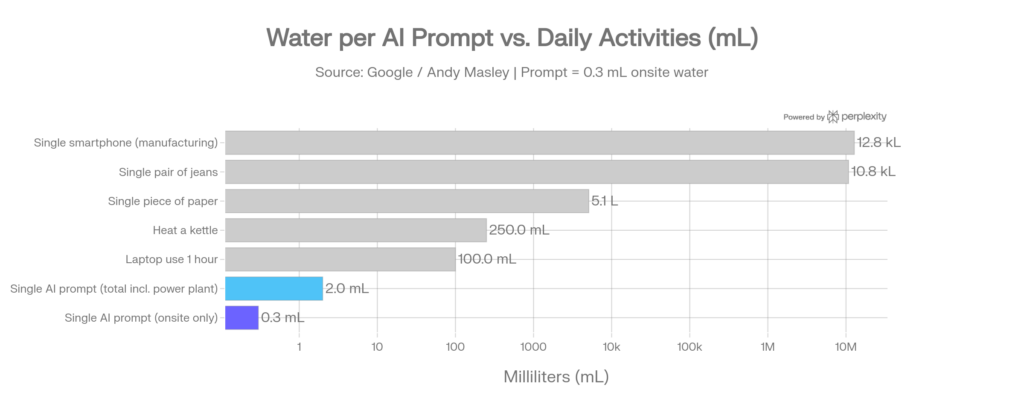
The correct figure, consistent with Google’s own published Gemini data, is approximately 0.3 mL of water used inside a data center per AI prompt. Even including offsite power plant water (which is mostly returned to its source unaffected, and much of which would evaporate from hydroelectric reservoirs regardless), total water per prompt is roughly 2 mL — not 500 mL.
Critically, Ren himself has since acknowledged that the actual water cost of GPT-4 was likely around 15 mL total (not 500 mL), and that models have become significantly more efficient since.
Claim 3: “AI Is Draining America’s Water Supply”
The Claim
Numerous articles have framed AI’s water use as a national crisis. Karen Hao’s book Empire of AI states that “surging AI demand could consume 1.1 to 1.7 trillion gallons of fresh water globally a year by 2027, or half the water annually consumed in the UK.” The book also describes a Google data center in Chile as using “more than 1,000 times the amount of water consumed by the entire population of Cerrillos, roughly 88,000 residents.”
The Numbers Don’t Support This
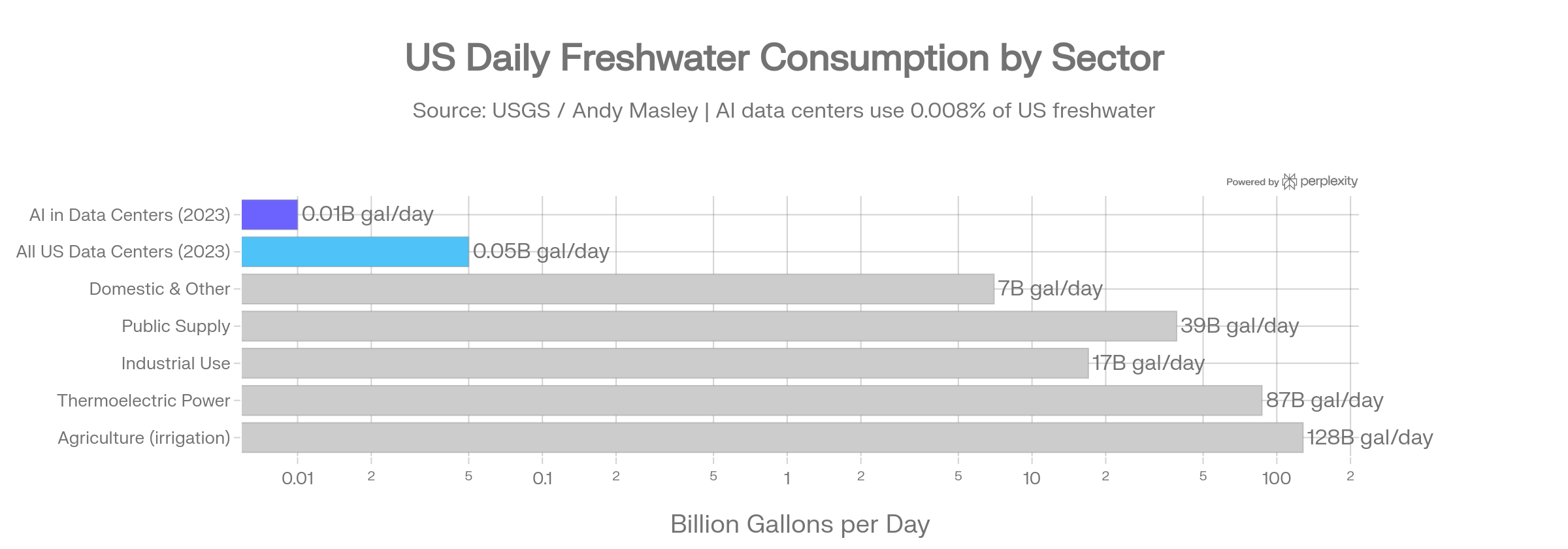
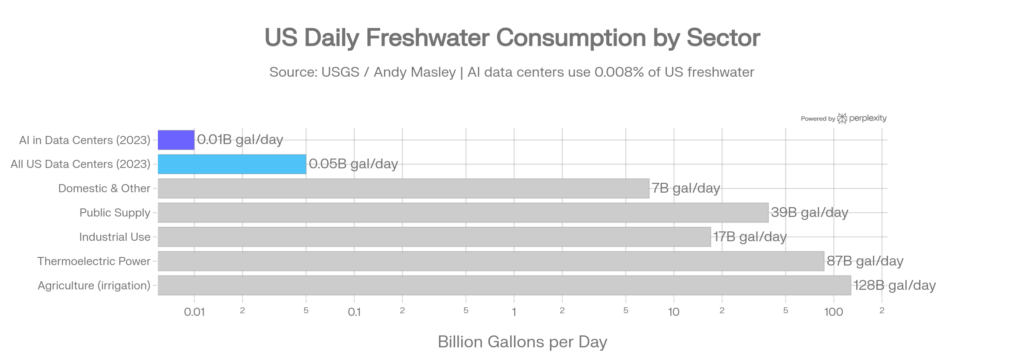
On the national level: All US data centers (which support the entire internet, not just AI) consumed approximately 200–250 million gallons of freshwater daily in 2023. The US consumes approximately 132 billion gallons of freshwater daily. Data centers used roughly 0.2% of the nation’s freshwater that year — and only 0.04% was used inside data centers themselves.
AI specifically represents about 20% of data center electricity and therefore roughly 0.008% of US freshwater consumption — equivalent to adding eight towns of 16,000 people.
Even by 2030, with AI’s water footprint growing 10×, AI data centers would consume approximately 0.08% of US freshwater — comparable to 5% of what US golf courses currently use.
On the “1.7 trillion gallons” claim in Empire of AI: The UC Riverside study Hao cites specifically measures water withdrawal, not water consumption. The study’s very next sentence notes that actual water consumption is only 10% of the withdrawal figure — and 90% of that withdrawal is returned to its source unaffected. The actual drinkable-water figure (potable water used inside data centers) is only about 3% of the number Hao cites.
On the Chile data center: Hao’s claim that Google’s proposed data center would use “1,000 times” the water of Cerrillos’s 88,000 residents contains what appears to be a units conversion error. The city’s water figure is reported in cubic meters but treated as liters, making the city appear to use 1,000× less water than it actually does. The correct framing is that the data center would raise the municipal water system’s demand by approximately 3% — significant, but not remotely comparable to 1,000 cities’ worth of consumption. Hao has since updated the book based on this criticism.
On local impacts: A comprehensive review of every major data center location in the US — including The Dalles, Oregon (most water as % of local supply); Loudoun County, Virginia (most total water); and Maricopa County, Arizona (highest water stress) — found no examples where normal data center operations harmed household water access. The only documented water issues trace to construction sediment runoff, not operational water draw. Several communities have seen improved water infrastructure funded by data center partnerships.
Claim 4: “Data Centers Are Devouring America’s Land”
The Claim
Media coverage regularly frames data center expansion as “gobbling up farmland” and threatening food security. Videos of farmers “bravely resisting” data center land offers have gone viral, framing tech companies as villains displacing food production.
Reality: Tiny Footprint, Massive Revenue
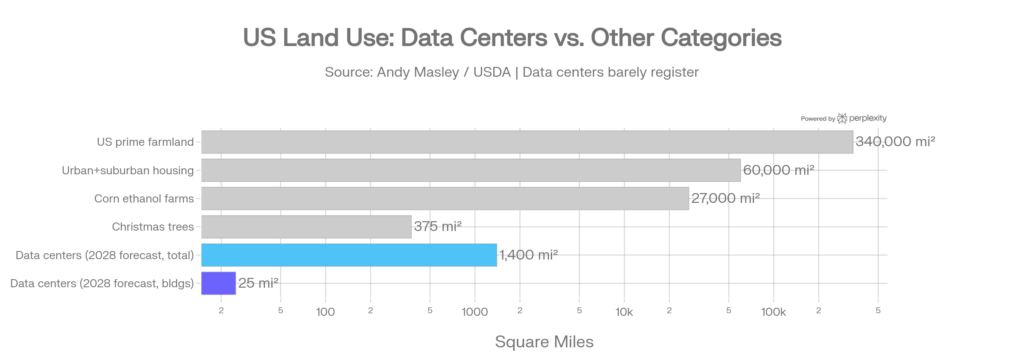
By 2028, all US data center buildings will collectively occupy approximately 25 square miles. The total land including surrounding parcels will be roughly 1,400 square miles. For context:
- US prime farmland: ~340,000 square miles
- US corn ethanol farms alone: ~27,000 square miles (19× all data center land)
- Urban and suburban housing: ~60,000 square miles
- Christmas tree farms: ~375 square miles (15× data center buildings)
- Federal Conservation Reserve Program (paid idle farmland): ~40,000 square miles
In Loudoun County, Virginia — home to the world’s largest concentration of data centers — data centers occupy just 3% of county land while generating 38% of all county general fund revenue. In Maricopa County, Arizona, data centers use 0.12% of county water while generating 50× more tax revenue per gallon than golf courses, which use 3.8% of county water.
Data center land also largely does not compete with housing. Data centers want flat, cheap, exurban land near power and fiber infrastructure — fundamentally different from the urban infill land where housing shortages exist.
Moreover, data centers have freed up far more land than they use by enabling the collapse of retail real estate, bank branches, video rental stores, and office demand. Amazon’s ~11 square miles of warehouse space now handles a massive share of retail that previously required hundreds of square miles of stores and parking lots.
Claim 5: “Data Centers Are Raising Temperatures Around Them by 2–9°C”
The Claim
A 2025 paper titled “The Data Heat Island Effect: Quantifying the Impact of AI Data Centers in a Warming World” claimed that data centers cause land surface temperatures to increase by an average of 2°C, with extremes of 9°C, affecting 340 million people worldwide. The paper was widely shared and reported as proof that AI infrastructure is creating localized climate disasters.
The Methodology Is Fundamentally Flawed
The paper measures land surface temperature (LST) — the temperature satellites measure of the ground surface, not air temperature — and attributes the increase to data center heat exhaust. This conflates two entirely different phenomena.
Buildings are dramatically hotter to the touch than grass on a sunny day — by roughly 20–35°C. When a satellite measures the average surface temperature of a 1 km² pixel and that pixel now contains a large building plus parking lots instead of a field, the blended average temperature will be higher. This has nothing to do with the heat the building’s equipment generates and would be equally true for a Walmart, a warehouse, or any other large building.
A basic physics calculation confirms this: even assuming 100% of a 100 MW data center’s waste heat somehow reached the surrounding ground surface within a 1.6 km radius — which is physically impossible, since heat rises and disperses — the maximum possible ground heating would be 0.02–0.05°C, roughly 1–3% of the observed 1.5°C signal. The remaining 97–99% is simply the satellite detecting a new hot building where grass used to be.
The authors do not consider this obvious alternative explanation anywhere in the paper. Their proposed mitigations — “use more efficient AI algorithms” and “adiabatic circuits” — only make sense if they believe the cause is server heat output rather than building construction, confirming their unstated but incorrect assumption.
The 340 million “affected people” figure is also generated by counting everyone within 10 km of a data center, regardless of whether they experienced any actual change in air temperature, health outcomes, or quality of life — the same methodology would yield “billions affected by Walmart”.
Claim 6: “Data Centers Are Poisoning Local Water Supplies”
The Claim
A widely-shared New York Times headline, repeated constantly in AI criticism, implied that Meta’s data center caused residents’ taps to run dry in a rural community. This has become a reference point for claims that data centers regularly contaminate or deplete local water.
Construction vs. Operation: A Critical Distinction
The New York Times article itself acknowledges that the tap water issue was caused by sediment runoff during construction, not by the data center’s normal operational water use. The facility hadn’t even started operating at the point the water problem occurred. Conflating construction impacts with operational impacts is a persistent source of confusion in this debate.
Data centers do not introduce novel chemical pollutants into water. Cooling water circulates in closed loops; any discharge goes to municipal wastewater treatment under permit. EPA national assessments consistently identify agriculture — not data centers — as the leading source of water impairment in rivers, streams, and aquifers, primarily through nitrogen and phosphorus runoff.
A striking example: the Morrow County, Oregon water crisis — often cited as evidence of data center water harm — was caused by 35 years of agricultural nitrate over-application that Oregon’s government repeatedly declined to regulate. When an Amazon data center was built nearby and used a small fraction of local water, critics superimposed cancer cells on server racks. The actual source of nitrate pollution, unchallenged for decades, was irrigated agriculture.
Claim 7: “AI Companies Are Abandoning Their Clean Energy Commitments”
The Full Picture
It is true that the emissions of major tech companies rose in 2024–2025. Amazon’s emissions rose 16% from 2024; Google’s rose 18%. Microsoft has faced scrutiny over whether it can meet its 2030 carbon-negative commitment amid rapid data center expansion.
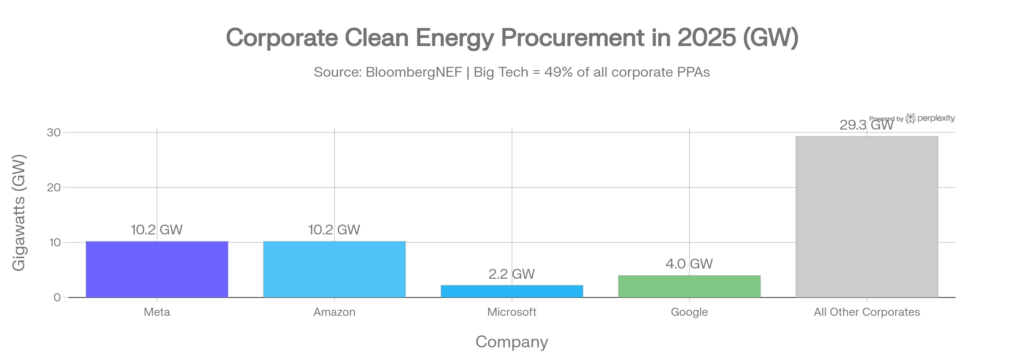
However, the same companies are simultaneously the largest purchasers of clean energy in the corporate world. Meta, Amazon, Google, and Microsoft collectively accounted for 49% of all corporate clean energy procurement in 2025 — a combined 26.6 gigawatts of new renewable and nuclear contracts.
Microsoft committed to matching 100% of its electricity with renewable energy purchases, achieving that goal for the first time in 2025 by contracting 40 GW of new renewable capacity across 26 countries. Amazon, Google, Meta and Microsoft launched a joint Data Center Innovation Initiative in 2026 to fund startups developing advanced liquid cooling, energy storage, and low-carbon building materials.
Claim 8: “Data Centers Are Economically Harmful to Host Communities”
The Claim
Community opposition groups frequently frame data centers as extractive: they take up land and water, bring few jobs, and benefit only distant tech companies.
The Economic Reality
Data center construction spending rose 31% year-over-year in January 2026, reaching $46.9 billion annually. The economic benefits flow into host communities in measurable ways:
- A single Ohio data center project generates approximately $2.4 billion in total economic output and 9,700 construction jobs during the build phase, with a GDP contribution of ~$1 billion
- Virginia data centers collectively support 74,000 jobs annually (construction and ripple effects) and contribute $9.1 billion to state GDP — with some jurisdictions seeing data centers account for up to 30% of local tax revenue
- Numerous communities have received upgraded water infrastructure, workforce training programs, and university research partnerships as part of data center development agreements
The criticism that data centers bring few direct operational jobs is valid — these are highly automated facilities. But the tax revenue per acre, per gallon of water, and per unit of electricity is dramatically higher than almost any competing land use. A community that uses data center tax revenue to fund schools, roads, and water systems is not being harmed by this trade.
What Is Actually True: Real Challenges Worth Addressing
A fair assessment acknowledges that some concerns are legitimate:
Electricity demand is real and growing. US data centers are projected to account for 6.7–12% of total US electricity consumption by 2028. The IEA projects global data center electricity consumption will more than double by 2030. This is a genuine infrastructure and grid challenge, though one driven largely by demand that creates enormous economic value.[^1]
Smart siting can dramatically reduce impacts. Cornell University researchers found that through smart siting, and operational efficiency, AI data centers could cut projected CO₂ emissions by 73% and water consumption by 86% compared to business-as-usual.
These are real engineering and policy challenges. What they are not is evidence that AI data centers are uniquely, catastrophically bad for the environment relative to other industries — or that individual users should feel guilty for sending a chatbot prompt.
The Pattern: How Misinformation Spreads
The history of data center environmental panic follows a consistent pattern identified across multiple examples:
- A study using flawed methodology or unit errors produces an alarming number
- The number is picked up by media outlets prioritizing clicks over accuracy
- Misleading comparisons (individual vs. industrial scale; withdrawal vs. consumption) amplify the alarm
- Corrections receive a fraction of the original coverage
- The wrong number becomes embedded in “common wisdom” and is cited in subsequent books and papers
The original UMass Amherst emissions study is the clearest example: off by 90×, cited by 2,730 papers, still uncorrected. The “bottle of water per prompt” is another: off by 50–250×, corrected by its own author, still appearing in news articles published in 2026.
This pattern is not unique to AI. A 1999 Forbes article warned that “a lump of coal is burned every time a book is ordered online.” Concerns about digital video’s carbon footprint in 2019 used similarly decontextualized numbers. Each time, the contrast between ephemeral-seeming digital activity and physically tangible resources triggers alarm that the actual numbers do not justify.
Conclusion
The environmental and community case against AI data centers largely rests on a small number of errors that have been amplified far beyond their evidence base. Training emissions compare unfavorably to individual activities but favorably to any similar-scale consumer product. Water use is real but represents a fraction of a percent of national consumption. Land use is minimal compared to agriculture, retail, and housing. Heat exhaust affects buildings, not surrounding land. The companies involved are simultaneously the largest corporate buyers of clean energy in history.
The legitimate concerns — electricity grid pressure — deserve serious policy attention. But the moral panic that data center expansion is an environmental crime comparable to industrial pollution is not supported by the numbers, and has been consistently fed by comparisons that would make any popular product look catastrophic if applied consistently.