“Nothing really compares to beef, lamb, pork, and dairy — but it’s essential to be mindful about everything we consume.” — Joseph Poore, University of Oxford
The promise of a plant-based diet is powerful: eat less meat, save the planet. And at an individual level, switching away from beef and dairy does meaningfully reduce one’s carbon footprint. But the full picture of industrial-scale vegan food production is far more complicated — and far more damaging — than the clean green branding suggests. When soy, almonds, avocados, and palm oil are farmed at industrial scale, the consequences reach across continents: vanishing rainforests, depleted aquifers, collapsing insect populations, and communities stripped of water and land. This article examines those consequences in detail.
The Monoculture Problem
At the heart of industrial vegan farming lies a fundamental contradiction. The crops demanded by a mass-market plant-based food system — soy, corn, canola, almonds — are almost universally grown as monocultures: single crops planted across vast, uniform tracts of land with no diversity.
Monocultures are structurally fragile ecosystems. Planting the same crop year after year depletes specific soil nutrients, compacts the earth, and creates the perfect conditions for pests and pathogens to flourish unchecked. The solution the industry reaches for is always the same: more synthetic fertilizer, more pesticide. This locks farms into a chemical treadmill that degrades the land over decades while poisoning everything living in and around it.
Research from the French National Institute for Agricultural Research links post-WWII monoculture farming directly to the dramatic reduction of farmland biodiversity observed across the industrialized world. The practices adopted since the 1950s — large monoculture fields, heavy chemical use — have “adversely affected the health of farmers and consumers and dramatically reduced farmland biodiversity.”
Deforestation: The Soy Machine
No single crop illustrates industrial vegan farming’s destructive footprint more starkly than soy. Soy is a cornerstone of plant-based food — tofu, tempeh, soy milk, edamame, meat analogues — but its industrial cultivation has consumed South America at a staggering scale.
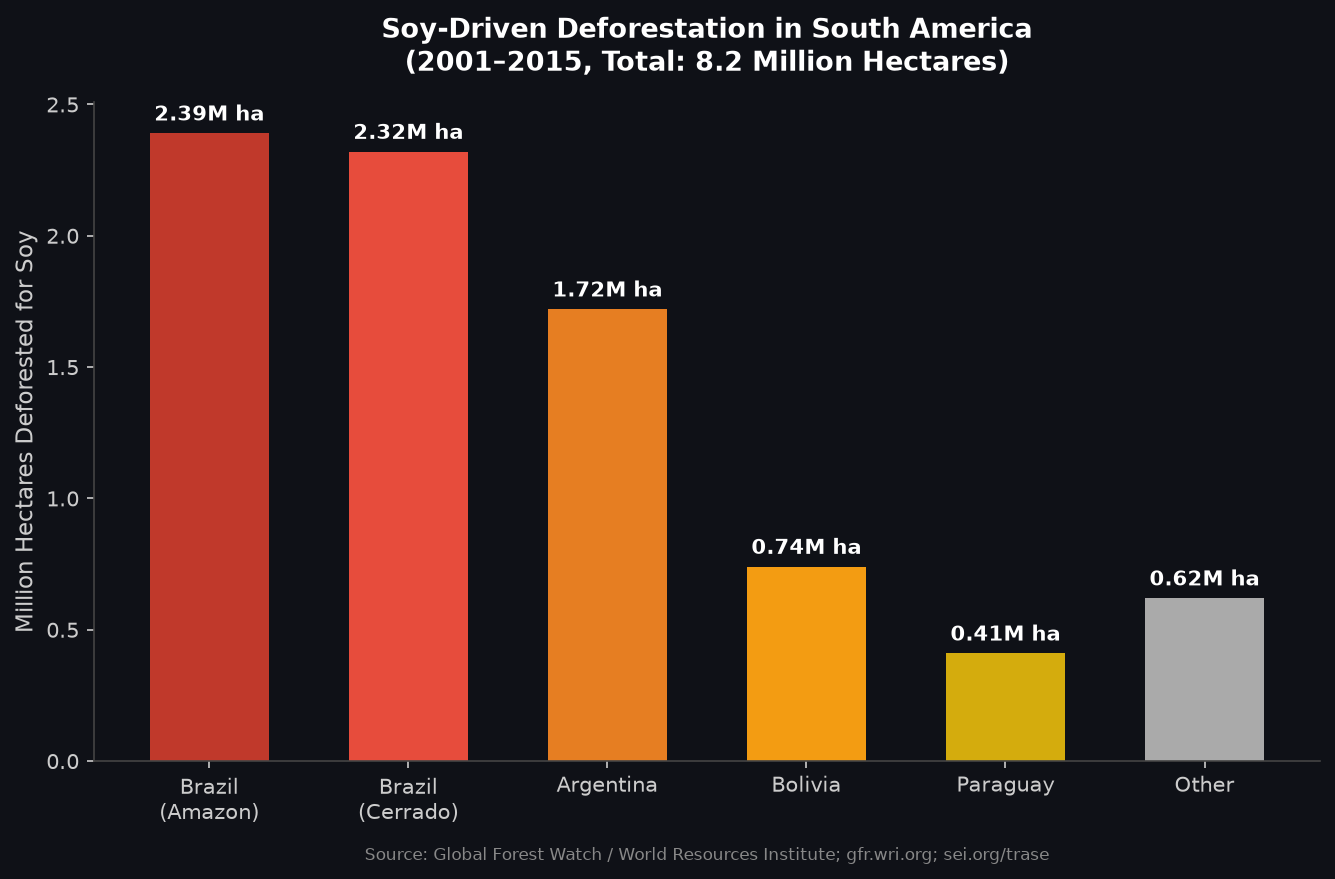
Between 2001 and 2015, soy farming was directly responsible for the deforestation of 8.2 million hectares of land globally, according to Global Forest Watch data compiled by the World Resources Institute. That is an area larger than Austria — and 97% of it was in South America.

Brazil’s share was the largest. The Amazon and the Cerrado — a vast tropical savanna spanning 2 million square kilometers — together absorbed the majority of soy expansion. The Cerrado has already lost more than half its native vegetation, much of it converted to soy fields. In 2022 alone, soy-linked deforestation in Brazil released 121 million tonnes of CO₂ — equivalent to 9% of the country’s total land-use emissions for that year.
The pace has not slowed. A 2022 Mongabay investigation found at least 42,000 hectares of primary Amazon forest directly cleared and burned for soy in Mato Grosso state since 2020. In early 2024, Mighty Earth satellite monitoring detected 25,207 hectares of soy-linked deforestation in the Cerrado and 8,782 hectares in the Amazon in just four months.
The crops displacing these ecosystems are not feeding people who choose not to eat animals. The majority of the world’s soy — roughly 70–75% — is used as animal feed. But the remaining fraction destined for human plant-based food is still part of the same industrial supply chain, sourced from the same landscape of displacement and destruction. Soy production has risen by approximately 30% per decade globally, with no end in sight.
The Thirst of “Healthy” Foods
Water is the second front of industrial vegan farming’s impact. Certain crops — particularly nuts and tropical fruits that dominate plant-based and health-food markets — are extraordinarily water-intensive, and they are frequently grown in the driest, most water-stressed regions on Earth.

Almonds: California’s Most Controversial Crop
Almonds have become the symbol of plant-based dairy. Almond milk has surged to dominance on supermarket shelves across North America and Europe. The environmental cost is concentrated in California’s Central Valley, where 80% of the world’s almonds are grown.
Producing one kilogram of shelled almonds requires approximately 16,095 liters of water — among the highest of any food crop. California’s almond industry collectively consumes 4.9 to 5.7 million acre-feet of water per year, representing up to 17% of total agricultural water use in a state that is routinely gripped by severe, multi-year drought. This demand strains aquifers that took thousands of years to fill and will not recover on any human timescale.
Avocados: Exporting Water in the Form of Fruit
The avocado boom has been even more geographically devastating. Mexico’s Michoacán state produces the majority of the world’s avocados. Avocado trees consume four to five times more water than native pine species, and in Petorca, Chile — a key export region — it takes 320 liters of applied water to grow a single avocado.
Globally, around 9.5 billion liters of water are used daily for avocado production — equivalent to 3,800 Olympic swimming pools, every single day. In Michoacán, avocado irrigation demands in 2020 were estimated to require at least 70% of the region’s total available freshwater, far exceeding natural replenishment rates.
The response from farmers has been illegal water extraction. A former Michoacán water official estimates that over 50% of wells in the region are illegal, diverting water from rivers and underground aquifers to irrigate orchards. Communities downstream lose access to drinking water. As one community leader in Michoacán put it: “They export our water in the form of fruit.”
In Mexico, the avocado industry has also driven illegal forest clearing — over 70,000 acres in the past decade — as farmers raze pine and fir forests to plant orchards, compounding water loss with soil erosion and carbon release.

Pesticides and the Insect Apocalypse
Industrial monoculture farming requires chemical warfare to sustain itself. Without the natural pest control that biodiversity provides, monocrops are vulnerable to insect outbreaks, fungal disease, and weed competition. The industry’s solution is blanket pesticide application.
Pesticide use has risen fivefold since 1950, with over 4 million tonnes sprayed on fields worldwide each year. The consequences for insect populations have been catastrophic.

A 2024 literature review published via Beyond Pesticides found that pesticide use is now the primary driver of insect species and population collapse — greater than urbanization, deforestation, or climate change in isolation. The average global pesticide application rate is 4.4 kg per hectare per year, across land that covers roughly one-fifth of Earth’s surface. In some regions, individual insects have declined in biomass by 75% or more over 50 years.
This matters beyond ecology. Insects are the foundation of terrestrial food webs. They pollinate the crops that humans eat — including the vegan staples that depend on pollinators. Between 1961 and 2016, the proportion of cultivated land growing pollinator-dependent crops more than doubled, even as the diversity of those crops barely increased. Agricultural productivity now depends increasingly on a pollinator population being actively destroyed by the inputs required to grow those same crops.
Studies show that organic farming supports five times higher plant biodiversity and 20 times higher insect species richness compared to conventional monoculture — a damning indictment of the industrial model.
Soil: The Silent Casualty
Beneath the visible damage lies a slower catastrophe: the systematic destruction of topsoil. Monoculture farming depletes soil nutrients, causes erosion and compaction, and reduces the land’s long-term capacity to retain water. Synthetic fertilizers mask the depletion but do not reverse it.
Healthy agricultural topsoil takes centuries to form naturally. Industrial farming can strip it in decades. Poor soil structure reduces water infiltration, meaning more surface runoff, more flooding, and less capacity to buffer droughts. Globally, farmed soils are thinning — a slow-motion crisis that receives far less attention than the more visible issue of deforestation, despite being equally existential for long-term food security.
Synthetic fertilizer runoff causes a second layer of harm. Nitrogen and phosphorus washing off cropland into rivers and coastal zones trigger algal blooms that deplete oxygen and create dead zones where aquatic life cannot survive. The Gulf of Mexico dead zone — driven largely by Midwest agricultural runoff — is one of the largest in the world.
Palm Oil: Vegan, and Devastating
Palm oil deserves its own section because it is one of the most widely used ingredients in vegan processed food — from snacks to margarine to dairy-free ice cream — and it has one of the most severe environmental profiles of any commodity crop.
Converting rainforest to oil palm plantation releases approximately 174 tonnes of carbon per hectare, according to a study by EPFL and the Swiss Federal Institute for Forest Research. To put that in scale: clearing one hectare for palm oil produces carbon emissions equivalent to 530 people flying economy class from Geneva to New York. Oil palm ranks second only to cattle pasture in total global forest area destroyed, with 10.5 million hectares of forest felled for palm between 2001 and 2015.
Palm oil expansion has been concentrated in the biodiversity-rich peatlands of Indonesia and Malaysia — ecosystems that, when drained and burned, release thousands of years of stored carbon. The orangutan, the Sumatran tiger, and hundreds of endemic species have lost vast swaths of their habitat to make way for oil palm plantations producing an ingredient listed innocuously on the back of vegan snack packaging.
The Social Cost
The environmental damage has a human dimension that is often overlooked in conversations about sustainable diets.
- Water theft in avocado and almond regions deprives rural communities of access to rivers and aquifers they have depended on for generations.
- Land displacement is widespread where agricultural expansion lacks strong legal protections for indigenous and small-scale farming communities, particularly in Brazil, Mexico, and Indonesia.
- Cartel violence has followed the avocado boom into Michoacán, where criminal organizations have extorted farmers and committed violence to control the lucrative export trade — a supply chain element that ends at the salad bowl of health-conscious consumers in North America and Europe.
- Farmworker exposure to pesticides in almond, berry, and vegetable monocultures is a persistent public health crisis in California and other major agricultural regions.
Conclusion
The narrative that plant-based food is categorically good for the environment is incomplete. Industrial-scale farming of soy, almonds, avocados, and palm oil carries serious environmental consequences: 8.2 million hectares of forest cleared for soy in 14 years, daily avocado irrigation consuming 9.5 billion liters of water, a fivefold increase in pesticide use since 1950 driving insect collapse, and 174 tonnes of carbon released for every hectare of rainforest converted to palm oil.
These are not fringe findings. They come from Global Forest Watch, the Stockholm Environment Institute, the World Economic Forum, and peer-reviewed research published in Nature Communications and Ambio. They point toward the same conclusion: the environmental impact of food depends far more on how it is grown than what species it comes from. Industrial monoculture — whether it grows soy for tofu or corn for cattle — is fundamentally incompatible with ecological sustainability.
Demanding genuinely sustainable food means looking past the “plant-based” label and asking harder questions about where food comes from, who farmed it, and what was destroyed to grow it.