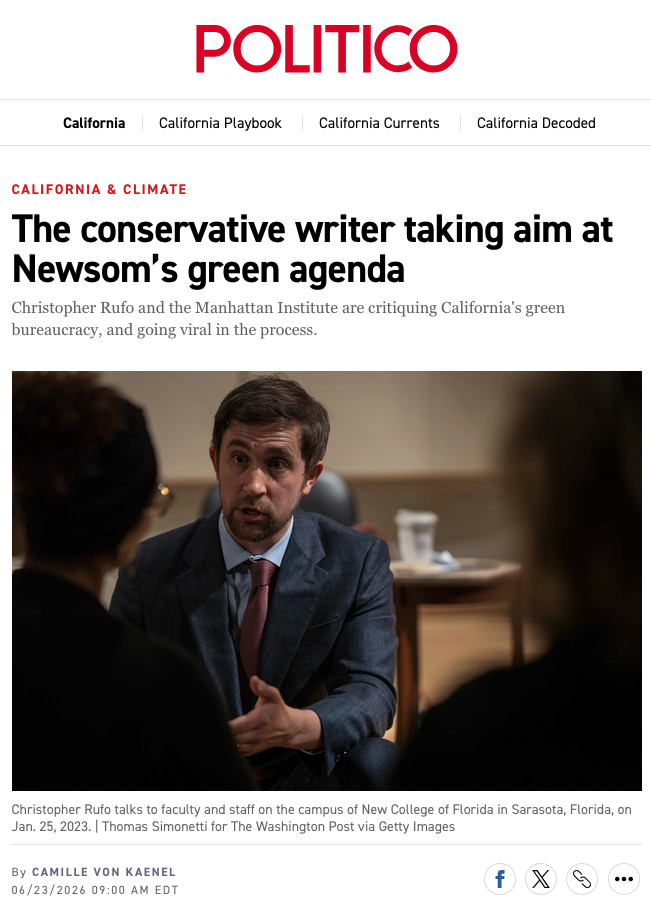
California’s government is running a legally and ethically dubious identity‑based contracting regime in its utility sector, yet the most prominent “legacy media” coverage has focused on pathologizing the messenger, Christopher Rufo, and defending Gavin Newsom’s green bureaucracy rather than scrutinizing the underlying system. That disconnect is now even harder to justify: the Department of Justice’s Civil Rights Division has opened a formal inquiry into the very program Rufo exposed, while outlets like Politico still cast him as the problem rather than the whistleblower.
What Rufo actually uncovered
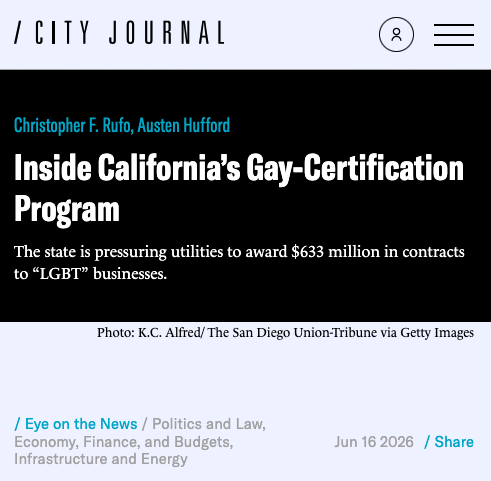
Rufo’s City Journal piece details a state‑engineered scheme at the California Public Utilities Commission (CPUC) that pressures regulated utilities to steer hundreds of millions of dollars in contracts to businesses certified as LGBT‑owned. In 2024 alone, the CPUC’s “Supplier Diversity Program” set a target that would direct roughly 1.5 percent of utility procurement—about 633 million dollars—to LGBT‑certified firms if the state’s largest utilities met the CPUC goal.
The program rests on an identity‑verification process that veers into the absurd: a business can qualify as “LGBT‑owned” via letters from advocacy groups, newspaper clippings describing the owner as LGBT, or even three letters from “personal contacts” written on company letterhead attesting to the owner’s sexual orientation. Supplier Clearinghouse, which administers much of this, also accepts documents such as HR complaints or police reports about alleged LGBT discrimination as part of the proof.
Rufo shows how these labels translate directly into preferential treatment in the marketplace. One example is Red Ace, a cybersecurity firm whose owner assembled a stack of documents—domestic‑partner affidavit, reissued birth certificate, and a therapist letter attesting to transgender status—to be certified as both woman‑owned and LGBT‑owned; a utility official then indicated that being on the diversity list made landing the contract “much easier.”
All of this exists in tension with California’s own constitutional order. Voters adopted Proposition 209 in 1996 to prohibit preferential treatment based on race, sex, or ethnicity in public employment, education, and contracting, and they decisively refused to repeal it in 2020. Yet the CPUC now sets numerical contracting “goals” for favored categories—15 percent minority‑owned, 5 percent women‑owned, 1.5 percent disabled‑veteran‑owned, and 1.5 percent LGBT‑owned—and then “encourages” compliance through mandatory demographic data collection, annual reports, and explanations from utilities that fail to hit the targets, a soft‑quota regime in all but name.
The punchline is that even with these incentives, actual market appetite for LGBT certification appears underwhelming: utility procurement with LGBT‑owned businesses fell 5 percent in 2024, and only 451 firms are LGBT‑certified out of 3,750 minority business enterprises tracked by Supplier Clearinghouse. Rufo’s core charge is that California has quietly built a politicized contracting system, dressed up as “supplier diversity,” that strains legal limits and prioritizes ideological symbolism over competence, cost, and reliability in critical infrastructure.
Now under federal civil‑rights scrutiny
The stakes here are no longer theoretical. The Department of Justice’s Civil Rights Division, led by Assistant Attorney General Harmeet Dhillon, has launched a formal inquiry into California’s LGBT‑contracting regime, focusing on the CPUC’s “gay‑certification” program for utility suppliers. According to public reporting and statements about the probe, DOJ is examining whether the state’s practice of steering up to roughly 633 million dollars in contracts to LGBT‑certified firms based on sexual orientation and gender identity violates federal civil‑rights and equal‑protection guarantees.
In other words, federal civil‑rights prosecutors now take this program more seriously than most national newsrooms do. If the identical scheme had been implemented by a Republican governor in Texas, it would be treated as a national scandal; in California, it is treated as a backdrop for yet another profile of a conservative villain.
How Politico reframes the story
Politico’s piece does not lead with these structural and legal issues; instead, it frames Rufo as “the conservative writer taking aim at Newsom’s green agenda.” The opening move is to center language and rhetoric—calling the policy a “gay certification program”—and its virality on X, noting amplification by Marc Andreessen and an opinion column in The California Post, rather than examining whether the underlying contracting program raises legitimate constitutional or governance problems.
From there, the article leans heavily on official pushback. A CPUC spokesperson characterizes the program as a “voluntary” initiative rooted in a decades‑old statute and points readers to a new section of the commission’s website designed to rebut “inflammatory rhetoric and selective facts,” implicitly placing Rufo’s work in that category. State agencies and Newsom’s press office are granted a broad framing: they depict Rufo’s investigations as “disingenuous outrage campaigns,” even as they admit they are forced to respond in lengthy threads on X.
The story then situates Rufo biographically—as a conservative activist known for fights over critical race theory and DEI, now backed by a Manhattan Institute team of ten focused on California—casting him as a political operator running a campaign against Newsom’s ambitions rather than as an investigative journalist surfacing concrete governance risks. Rufo’s scrutiny of California’s policy apparatus becomes one more front in a partisan war over 2028, not a substantive exposé that demands independent verification and follow‑up.
Narrative skewing and framing devices
Several framing choices in the Politico piece function as narrative skewing that protects the state’s green bureaucracy and the governor’s political project.
- The story foregrounds the phrase “gay certification program” and “outrage campaigns” while almost entirely sidelining the legal context of Proposition 209 and the question of whether CPUC’s identity‑based goals amount to de facto preferential contracting.
- It emphasizes that the program is “voluntary” and decades old, implying continuity and normalcy, yet does not grapple with how recent expansions to LGBT‑owned businesses and explicit numerical targets transform it into something more aggressive and legally contestable.
- The primary conflict presented is between a conservative activist and a progressive green state, not between taxpayers and a regulatory system that may be using monopoly utility dollars to engineer social outcomes that voters never explicitly endorsed.
These narrative choices invert the presumed burden of proof. Instead of asking whether CPUC’s rules are consistent with California’s constitution, procurement best practices, and ratepayer interests, the article asks whether Rufo’s tone and politics discredit his claims—effectively treating ideological positioning as the main fact in dispute.
What the coverage omits
The most telling bias lies in what is missing. Politico does not seriously engage with the detailed mechanics Rufo describes: the documentation standards for LGBT certification, the way utilities are cajoled through reporting obligations, or the tension with the electorate’s repeated insistence on race‑ and sex‑neutral government contracting. Nor does it explore the broader pattern of California’s governance problems that Rufo and others have documented, from large‑scale fraud in welfare and unemployment programs to expansive “woke” spending priorities—all of which provide context for why a niche‑sounding contracting rule matters.
Most glaringly, Politico does not treat the federal investigation as a story‑defining fact. The DOJ’s Civil Rights Division has formally notified California that it is probing whether the CPUC’s LGBT‑only contracting preferences amount to unlawful discrimination, yet this development is nowhere near the center of its narrative frame. In a functional press ecosystem, the moment DOJ opens a civil‑rights inquiry into a state’s utility‑contracting regime, that becomes the headline; here, it is overshadowed by the urge to present Rufo as a saboteur of the green agenda.
The article also omits the ratepayer and consumer angle. California utilities operate in a tightly regulated environment where costs are ultimately borne by households and small businesses; directing hundreds of millions of dollars based on identity categories rather than pure value and performance is a material governance choice, not just a culture‑war talking point. By failing to interrogate whether these contracting goals deliver better energy reliability, lower costs, or environmental benefits, Politico shields the program from the kind of outcome‑based scrutiny that would normally be applied to, say, defense contracting or pandemic spending.
Finally, Politico gives no real space to the argument—central to Rufo’s article—that identity‑based quotas in the utility sector are precisely the sort of preferential treatment Prop 209 was meant to prevent, even if they are laundered through “goals” and administered via private utilities rather than state departments. That omission is not neutral; it deprives readers of the key constitutional question and makes the controversy look like a matter of taste and rhetoric rather than of law and governance.
The bigger media pattern
Placed alongside Rufo’s detailed reporting, Politico’s treatment exemplifies a wider pattern in legacy media: when a conservative journalist uncovers potentially explosive structural problems in a progressive jurisdiction, coverage often reorients around the journalist’s ideology, funding, and style rather than the evidence itself. The story becomes “conservative activist attacks governor’s agenda,” not “regulator builds identity‑based contracting regime despite voter‑approved limits and now faces a DOJ civil‑rights probe.”
This dynamic does more than protect individual politicians; it protects entire bureaucratic architectures—from DEI bureaucracies to climate‑policy agencies—from outside accountability. In California’s case, the result is a public sphere where billions in green and welfare spending, plus targeted contracting schemes like the LGBT certification program, can expand with limited mainstream scrutiny, while those who raise alarms are framed as culture‑war arsonists whose motives obviate any duty to investigate.
Nothing exposes the skew more clearly than this sequence: Rufo uncovers a legally dubious identity‑based contracting scheme; the facts are serious enough that the DOJ’s Civil Rights Division opens a formal probe; and the flagship national write‑up is not “California’s green bureaucracy under federal civil‑rights scrutiny,” but “conservative writer taking aim at Newsom’s green agenda.” When even a federal investigation cannot pry reporters’ focus away from attacking the whistleblower, you no longer have watchdogs—you have narrative enforcers.